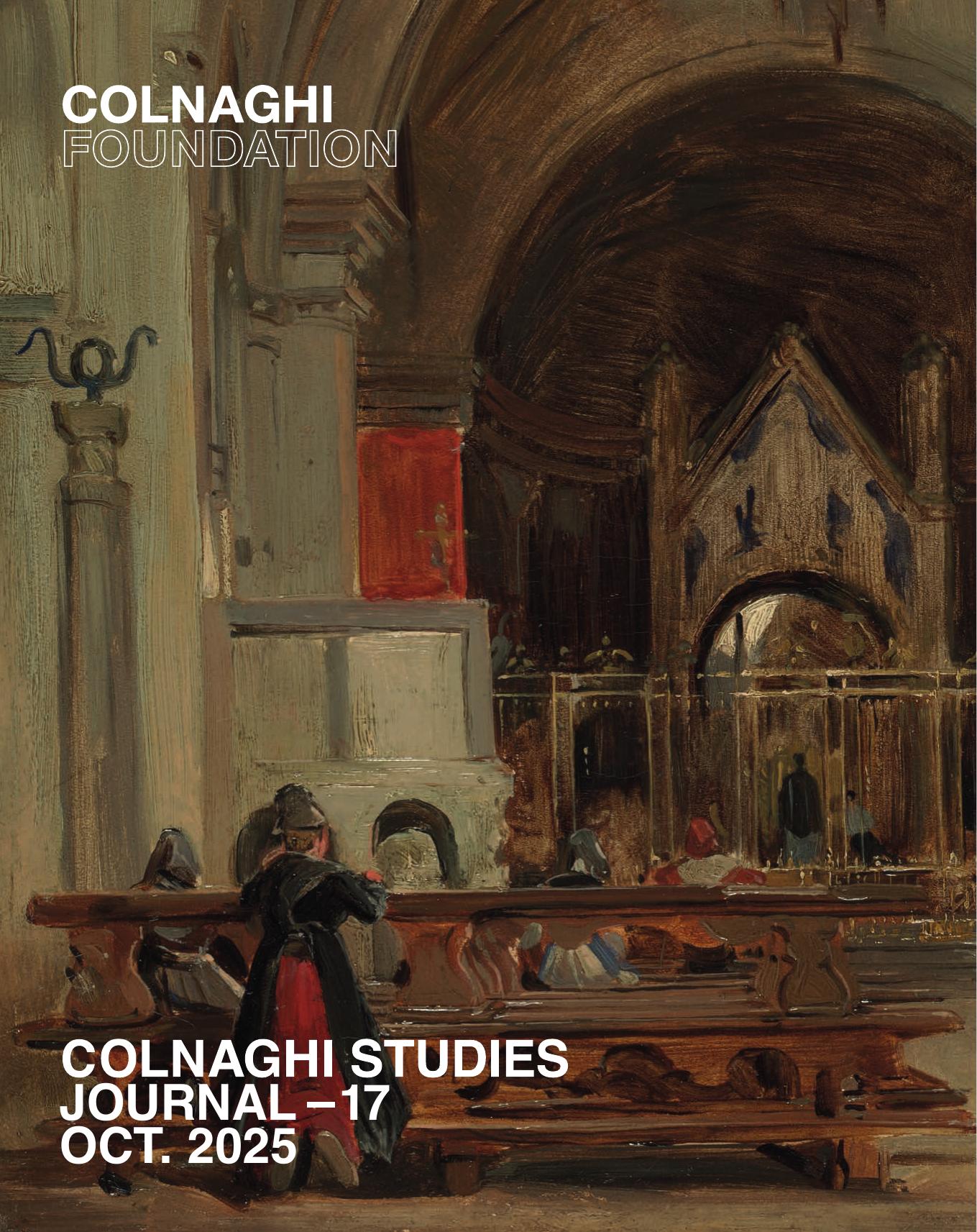
What Is the Colnaghi Studies Journal?
The Colnaghi Studies Journal was conceived as a space for careful, sustained thinking about pre-twentieth-century art. Published biannually by the Colnaghi Foundation, it is grounded in a simple conviction: that historic works of art continue to demand close attention, rigorous scholarship, and thoughtful interpretation.
Each volume brings together original research on artworks that have recently come to light, are undergoing reassessment, or sit at the centre of ongoing scholarly debate. Alongside these case studies, the Journal places particular emphasis on the history of collecting—how works have been acquired, valued, displayed, and understood over time, and how these histories shape our present engagement with art.
The Journal does not aim to provide definitive answers. Instead, it offers well-argued propositions, grounded in evidence, visual analysis, and archival research. Contributions typically situate individual works within the broader cultural, historical, and material contexts in which they were produced, tracing networks of artists, patrons, collectors, and institutions. Comparative imagery plays a central role, not as illustration but as a tool for thinking—allowing arguments to unfold visually as well as textually.
Editorial Independence and Peer Review
A defining characteristic of the Colnaghi Studies Journal is its editorial independence and peer-review process. Submissions are reviewed by an international Editorial Committee composed of specialists in painting, sculpture, architecture, conservation, decorative arts, and the history of collecting, spanning a wide range of periods and geographical areas. This breadth ensures that each article is assessed not only for originality, but also for methodological rigour and its contribution to wider scholarly discourse.
The Journal forms part of the broader activities of the Colnaghi Foundation, which supports research, publications, exhibitions, conferences, and educational initiatives in collaboration with museums, universities, and cultural institutions worldwide. In this context, the Colnaghi Studies Journal functions both as a record of ongoing research and as a platform for dialogue—connecting scholars, curators, conservators, and readers with a shared interest in historic art.
The Value of Slow Scholarship
Ultimately, the Journal is guided by the belief that slow scholarship matters. In an academic and cultural landscape increasingly shaped by speed and immediacy, it insists on the value of close looking, careful argument, and historical depth. Through this approach, the Colnaghi Studies Journal seeks to contribute not only to art history as a discipline, but also to a richer and more informed understanding of the works that continue to shape our visual and cultural inheritance.
Volume 17
The principles outlined above are fully reflected in Volume 17 of the Colnaghi Studies Journal. The essays gathered in this issue explore questions of collecting, taste, and interpretation across periods and media, combining close visual analysis with archival research and historiographical reflection. Together, they exemplify the Journal's commitment to careful scholarship and sustained inquiry.
Volume 17 may be read online, and readers who wish to download the full issue or access additional study features are invited to register.